“Juicebox is an AI-native organization.”
We love saying this. To prospective customers, candidates interviewing with us, and amongst ourselves as a reminder that we're working at the forefront of our industry.
And it's true! Look around our organization, and you'll find people using AI in genuinely incredible ways. A few months ago, our founding engineer Minchu wrote a well-received LinkedIn post1 reflecting on just this. I promptly clout-chased it with a quote reply2 about how empowering it's been to evolve my workflow as a designer.
Since joining Juicebox, I've unlocked capabilities I wouldn't have dreamed of a year ago: I’m more technically literate and I approach design problems more systematically and rigorously.
But the more I use AI, the more I've started questioning where its strengths lie and where we might benefit from a little more discernment.
First, the absolutely rad parts
I want to start by giving these tools their flowers, because they have fundamentally changed how I work.
-
Designing directly in code
In my past lives, getting a shipped experience to match Figma involved painful amounts of back-and-forth, QA, and compromise. Now with AI, I can refine the UI myself until it's exactly how I envisioned it. This has probably been the single most gratifying change to my workflow.
-
Moving really, really fast
The traditional Figma-to-engineering handoff barely exists anymore. We still design primarily in Figma, but sometimes engineering builds the initial UI shell and we take it from there. Other times, we build out much of the experience ourselves. The boundaries between design and implementation have become much more fluid, and we're able to move way faster because of it.
-
A new way to prototype
Gone are the hours spent wiring together Figma prototypes only to realize the solution wasn't even right. With agents, we can bring an idea to life with an interactive prototype, test whether it has legs, and scrap it if it doesn't without losing a whole day.
-
Ideation
Whether or not we're comfortable admitting it, these models are getting pretty good at coming up with elegant UI solutions. I frequently ask Codex to take a shot at a vaguely articulated problem and find myself thinking, "Huh, I hadn't thought of that."
The blank page problem is practically nonexistent now. There's always something to react to, iterate on, or push further. All of this has made me feel genuinely more capable as a designer, and I don't think I'd want to go back.
But that last point about the blank page is also where things start to get interesting.
Where AI might be holding us back
I've started noticing the ways that AI might be changing how I think and work - and not necessarily for the better.
-
Converging too quickly
As a young company, we've had the privilege of prioritizing shipping great solutions in weeks over spending months perfecting them. But that also means we don't always explore the opportunity space as thoroughly as we could, and AI can amplify this tendency. When it's so easy to create a high-fidelity prototype that already feels good, why bother exploring five other directions? The limiting factor might no longer be our ability to explore, but our willingness to.
-
Skipping the messy parts of product thinking
Tovin and I recently reflected3 on how much time we used to spend understanding user context, mapping journeys, and questioning assumptions before even opening a new Figma file. When AI makes it so easy to produce a plausible solution, I wonder if we're becoming less patient with the thinking that comes before it.
-
Losing the magic of thinking together
I miss a good old-fashioned FigJam brainstorming session, throwing stickies in a file, and building on each other's ideas. These sessions might feel inefficient now when an agent can generate dozens of ideas in seconds, but the value was always more than just the ideas. It was challenging assumptions, hearing different perspectives, and developing a shared understanding of the problem together.
Learning to be discerning
One of the things I love about working at Juicebox is how we're always experimenting with new ways to use AI. Our culture of curiosity is a huge part of what makes our team special.
But I think becoming a more mature AI-native company and design team means developing just as much discernment around when to use these tools as we have enthusiasm for how to use them.
That means asking hard questions:
- Which parts of the design process were simply tedious and which were helping us become better thinkers?
- Where does AI expand our ability to explore and where might it narrow our thinking?
- How do we preserve the collaborative parts of design that make us a stronger team?
I want us to keep asking these types of questions and challenging ourselves to do the harder thing when it's the more valuable thing.
Slowing down
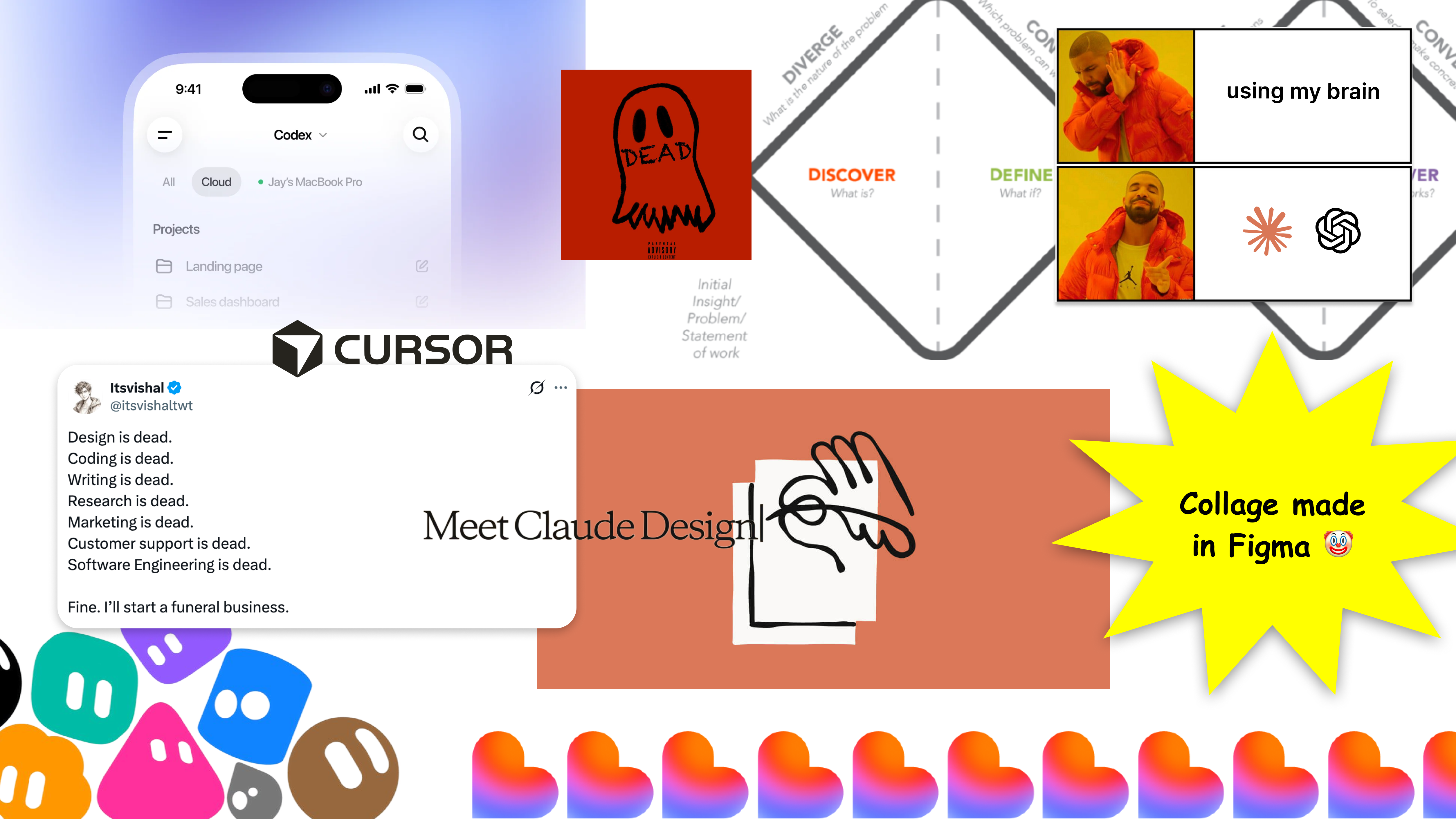
One of my favorite designers, Jenny Wen, has talked about how the design process as we knew it is dead.4 I don’t think she’s wrong. But she’s also shared another thought that's stuck with me: as everything gets faster, knowing when to slow down might become one of our most valuable skills.5
Here at Juicebox, we're getting pretty good at moving fast. Maybe it's time we got just as good at knowing when to slow down.